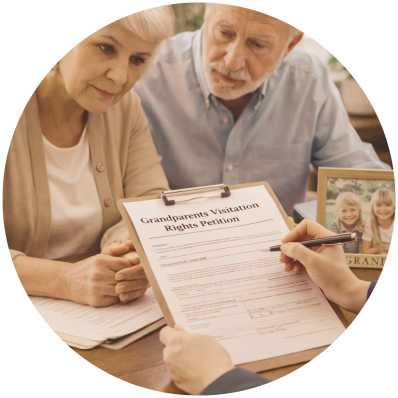
Third-Party Visitation in Nevada (Grandparent Rights): What the Law Really Says
When disputes arise over grandparent visitation or requests from other non-parents to see a child, Nevada courts must balance two powerful legal principles:
- a parent’s constitutional rights, and
- a child’s best interests.
Understanding how Nevada law treats third-party visitation is essential for parents, grandparents, and other friends or relatives considering court action.
Parents Have a Constitutional Right to Decide Who Sees Their Child
Under the Fourteenth Amendment, parents have a fundamental liberty interest in the care, custody, and control of their children. The U.S. Supreme Court confirmed this in Troxel v. Granville (2000), holding that courts must respect a fit parent’s decision about visitation unless strong legal grounds justify intervention.
The Court emphasized that there is a presumption fit parents act in their child’s best interests, and judges must give “special weight” to a parent’s wishes when someone else seeks visitation.
This constitutional principle is the foundation of Nevada’s third-party visitation law.
Nevada’s Grandparent & Third-Party Visitation Statute (NRS 125C.050)
Nevada allows certain non-parents to petition for visitation, but only in specific circumstances. Under NRS 125C.050, eligible petitioners may include:
- Grandparents or great-grandparents
- Siblings of a parent
- Individuals who lived with the child and formed a meaningful relationship
However, they can only file if a parent has denied or unreasonably restricted visitation.
The Strong Presumption in Favor of Parents
Nevada law mirrors constitutional protections by creating a rebuttable presumption:
If a parent has denied or restricted visitation, the law presumes granting visitation to a non-parent is not in the child’s best interests.
To overcome that presumption, the petitioner must prove, by clear and convincing evidence, that visitation is in the child’s best interests. This is a high legal standard, significantly higher than the typical “preponderance of evidence” test.
The Nevada Supreme Court reaffirmed this principle in Rennels v. Rennels, explaining courts must give special weight to a fit parent’s decision when evaluating third-party visitation requests.
Factors Nevada Courts Must Consider
If a petition moves forward, the judge must analyze statutory best-interest factors, including:
- Emotional ties between petitioner and child
- Ability to provide guidance and care
- Prior relationship and involvement
- Moral fitness and health of petitioner
- Child’s preference (if mature enough)
- Willingness to support the parent-child relationship
- Child’s medical and developmental needs
- Financial or emotional support provided
Courts may also consider any other relevant circumstance specific to the case.
When Grandparents Can Seek Visitation
A petition is typically allowed only if certain triggering events exist, such as:
- A parent is deceased
- Parents are divorced or separated
- Parents were never married but separated
- Parental rights were terminated or relinquished
Without one of these statutory conditions, a petition usually cannot proceed.
Special Situations
Nevada law also addresses unique scenarios:
- If parental rights are terminated, existing visitation rights for relatives usually end unless visitation remains in the child’s best interests.
- If a child lived with a non-relative who formed a meaningful bond, that person may also seek visitation after moving out.
- Visitation rights can be included in divorce decrees or custody orders.
Key Takeaway: These Cases Are Difficult to Win
Third-party visitation cases are intentionally difficult for non-parents to win. The law is designed to:
- Protect parental autonomy
- Prevent unnecessary court intrusion into family life
- Ensure visitation is ordered only when truly necessary for the child’s welfare
In practical terms, unless a petitioner can present strong evidence showing visitation is essential for the child’s well-being, courts generally defer to a parent’s decision.
FAQ – Nevada Grandparent Visitation
Can grandparents automatically get visitation in Nevada?
No. There is no automatic right. They must file a petition and meet strict legal standards.
What evidence is needed?
Clear and convincing proof that visitation is in the child’s best interests despite the parent’s objection.Does the judge have to follow the parent’s wishes?
Not always, but courts must give them special weight and start with the presumption the parent is correct.
If you have questions about grandparents’ visitation rights or your legal options, contact Surratt Law Practice to schedule a consultation and discuss how we can help protect your relationship with your grandchildren.